Factorio’s a great game, you should definitely play it - but play it before you read this post, in particular play the second one. This post has spoilers.
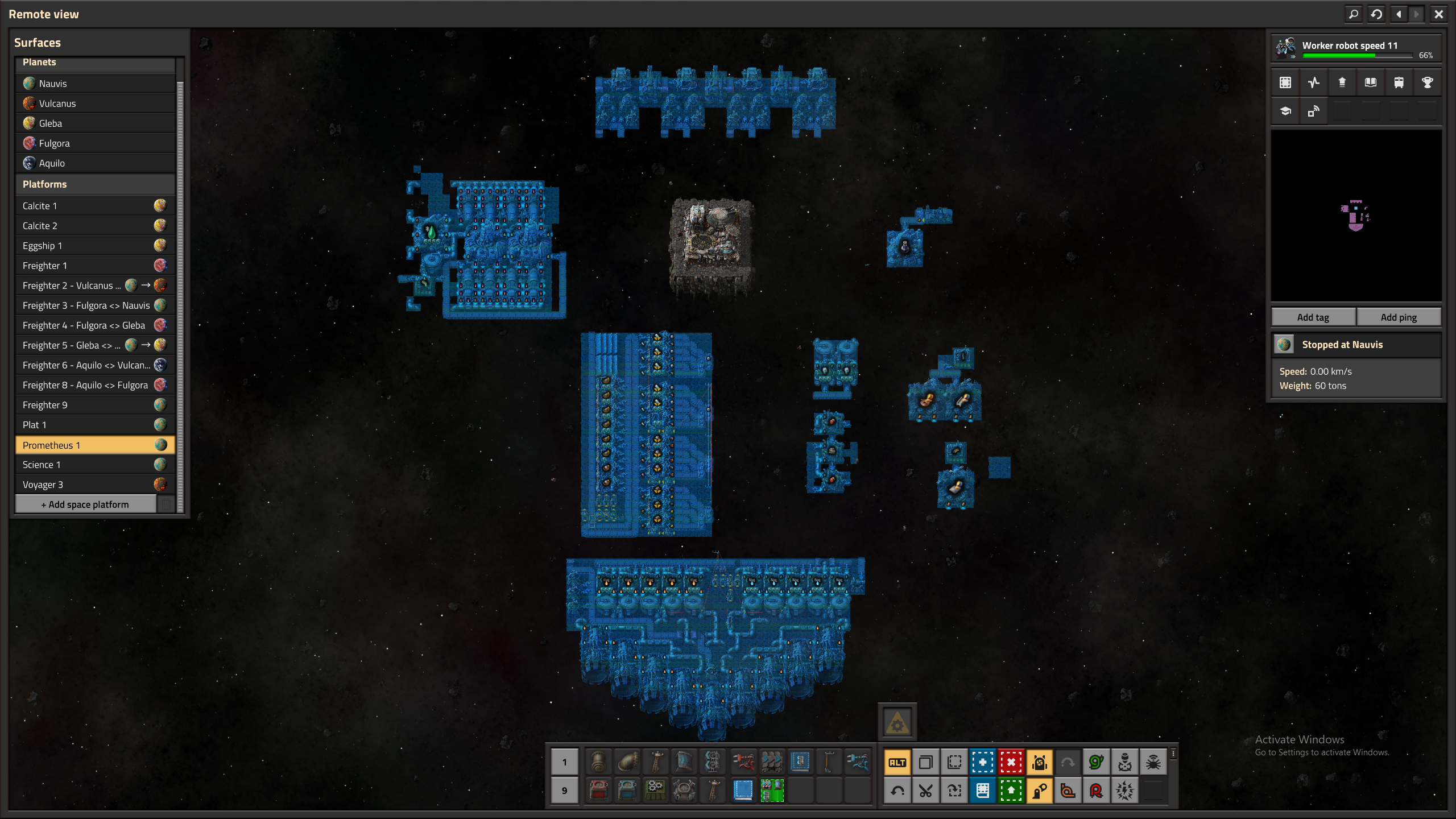
One especially interesting aspect I found was watching the evolution of my space platforms over the course of the game. As I expanded, got new technologies, and needed more from my platforms, I would typically copy and paste my previous version, and just update one or two parts of it as necessary. This led to a clear, mostly traceable, evolutionary hierarchy of my platforms.
It’s been a while since I played Factorio last, but before I start my next run, I wanted to document to the best of my memory this evolution for posterity.
The place to start, of course, is my first platform: Plat 1.
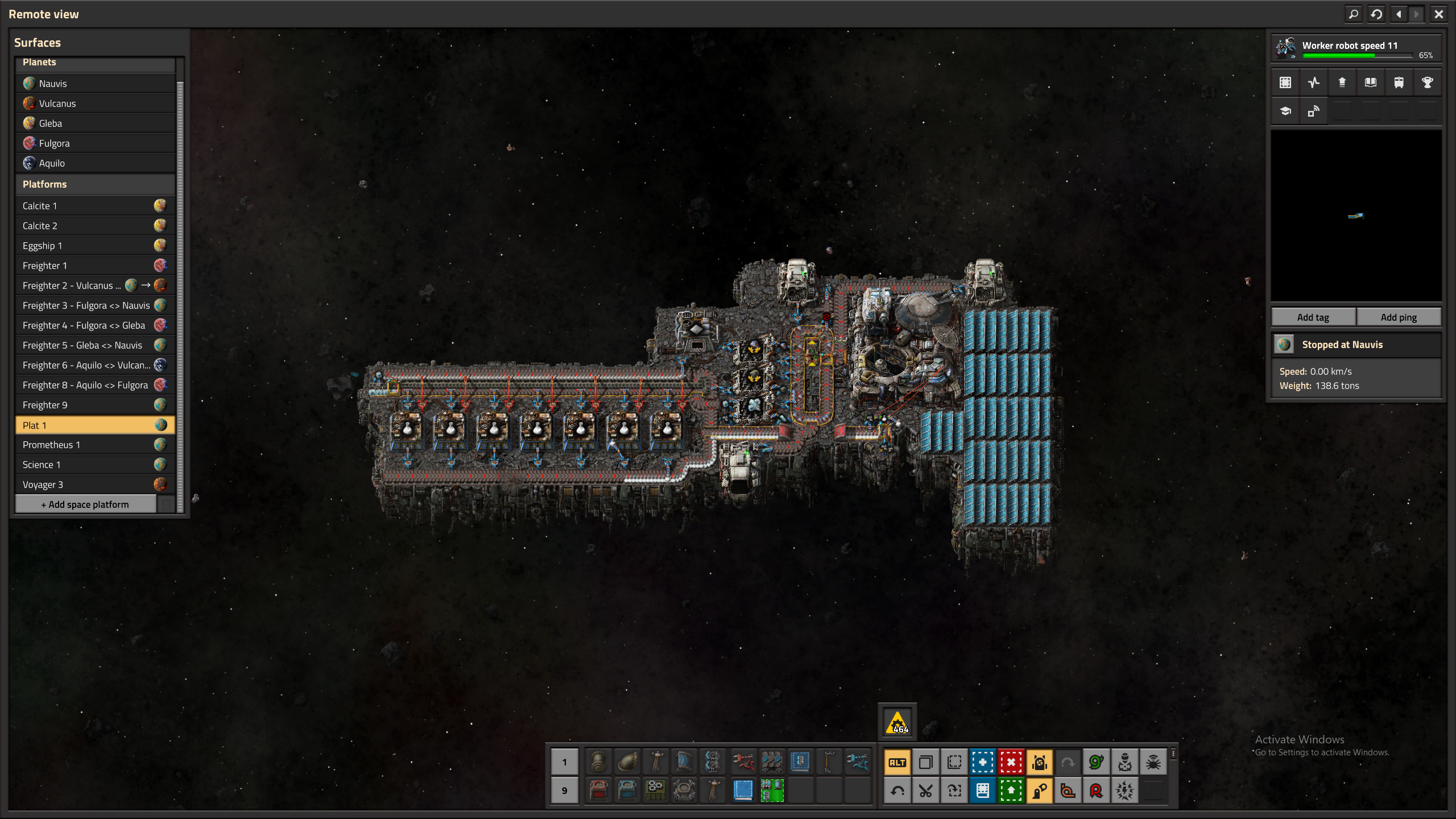
This is about as basic as they get: A few asteroid collectors, a sushi belt of raw asteroid fragments feeding crushers, which feeds a belt that feeds assemblers. Power on one side, assemblers extend off the other.
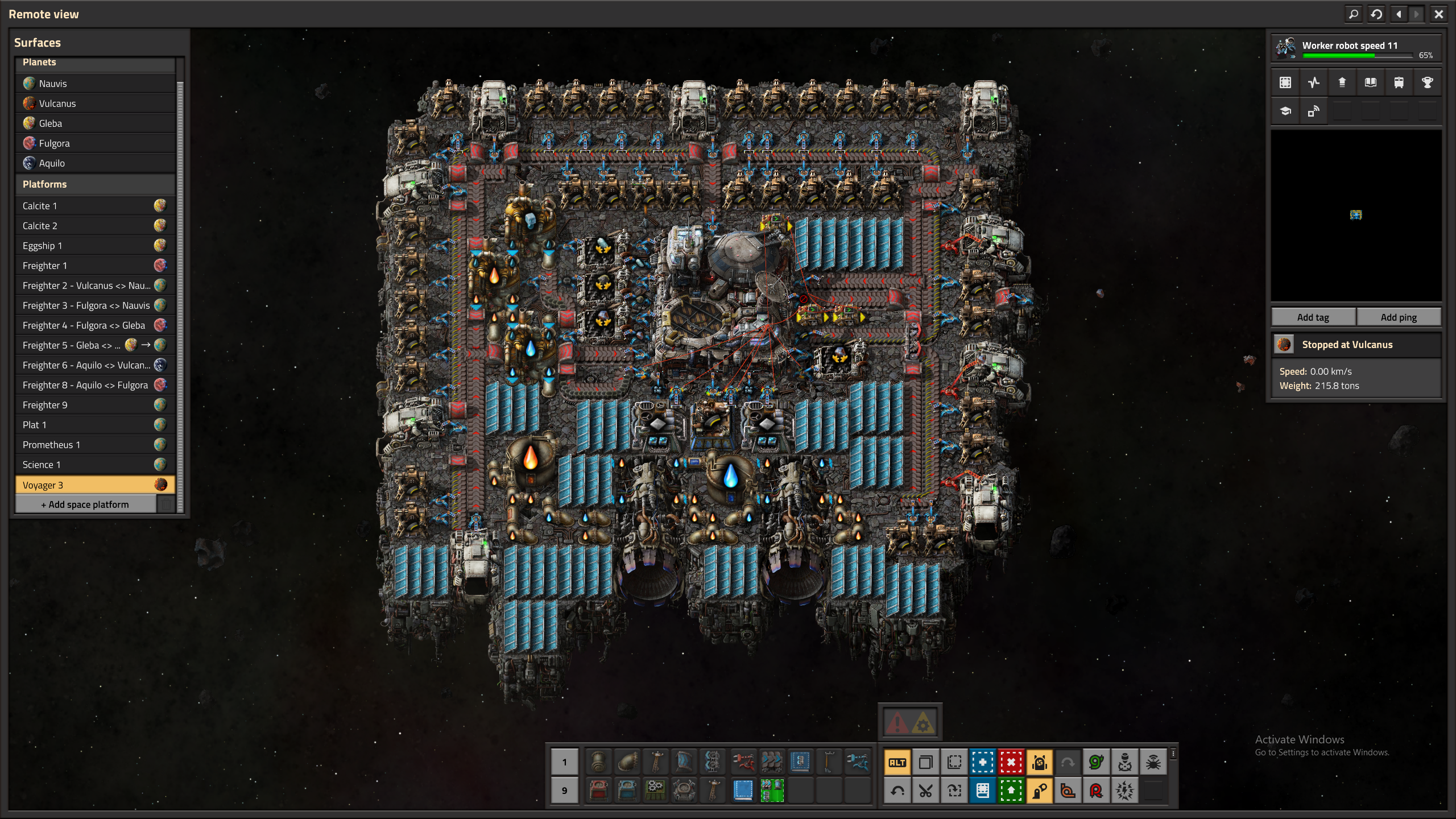
Voyager 1 and 2 did not survive, but Voyager 3 did. This is my first design which successfully cruised the stars, and which brought my to Vulcanus. It is almost maximally packed - it was, in fact, designed before I had a bot network, and had to be constructed in-situ from scratch on Vulcanus.
Two rows of belts around the edges: One collecting asteroid fragments from collectors, and another feeding ammo to turrets. The hub is used for storage, and for shuffling materials between many components: Asteroid fragments go to the hub, and get pulled out by the crushers. A few strategically-placed tanks power two thrusters. Solar panels are crammed in wherever they fit.
But, the hub only fits so much. So what’s the logical next step? Well, extend it, of course!
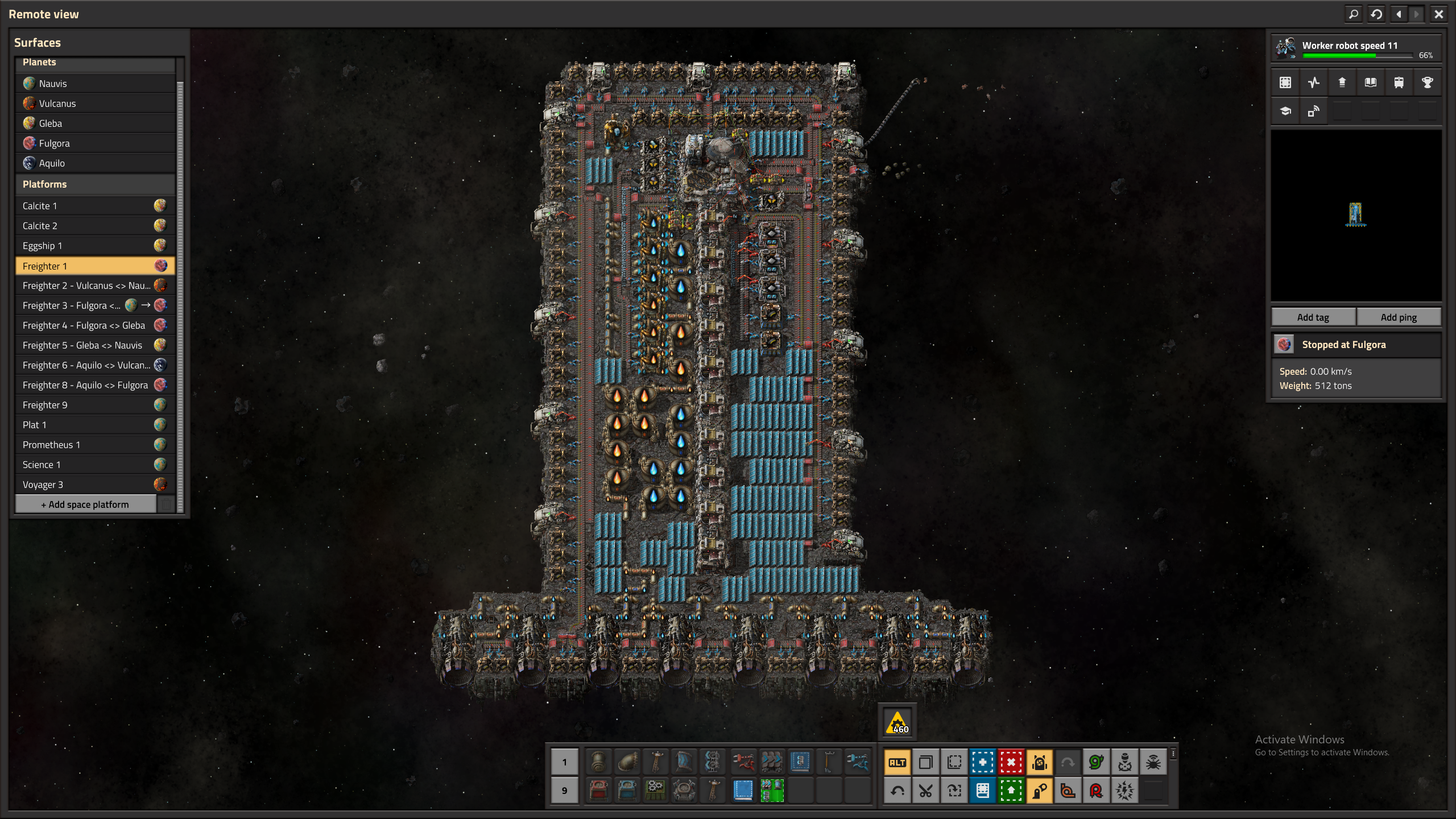
This is the exact same principle, but longer. The hub cargo storage and thrusters are extended significantly. There’s more fluid processing and ammo generation, and now iron plates feed the ammo assemblers without going back through the hub storage.
The operating principles are all the same: Resources move through the hub. Solar power to build up fuel and ammo while orbiting a planet. These fuel and ammo stores are used up while in transit. Where Voyager 3 would take substantial time to travel, Freighter 1 could make a trip in just a few minutes, but still required a 30+ minute wait time at the destination to refill its stocks.
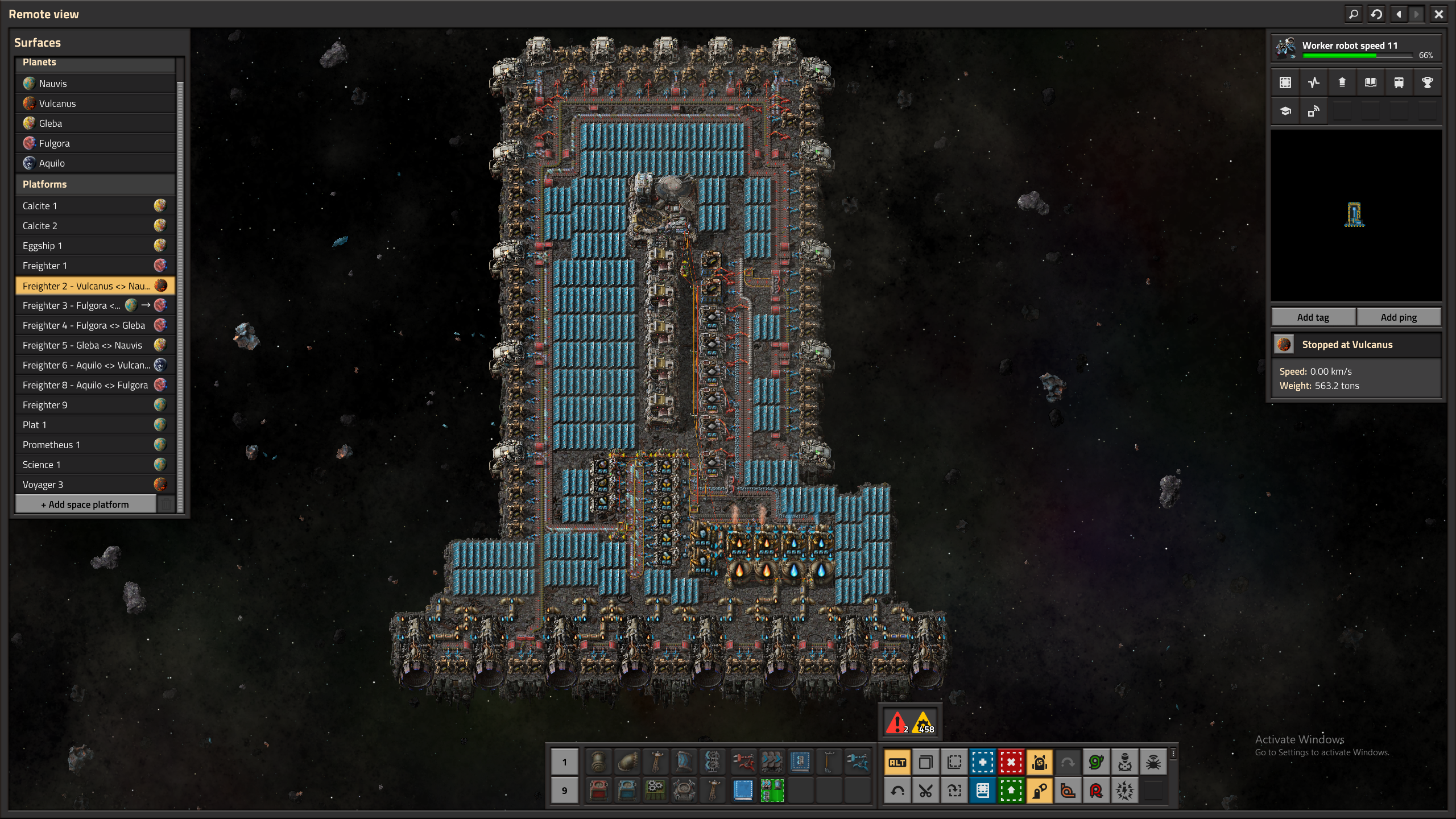
Freighter 2 is a step-function in optimization over its predecessor. It retains the same basic shape: Eight thrusters driving a long cargo area, with turrets and collectors aroudn the outside.
But the design of the ship is fundamentally changed, in two ways. First, on-platform processing doesn’t go through the hub any more. We go back to a sushi belt design, with circuit-driven asteroid reprocessing to keep the sushi belt balanced, and with the output crushers going on belts directly to their consumers. Secondly, the ship is designed to produce everything it needs on the fly, replacing a field of fluid tanks with just four fuel tanks and solar panels to provide enough power to drive all the speed modules.
Freighter 2 worked well enough that it was cloned, into Freighter 3. Due to material shortages there is exactly one missing component on Freighter 3, see if you can spot it:
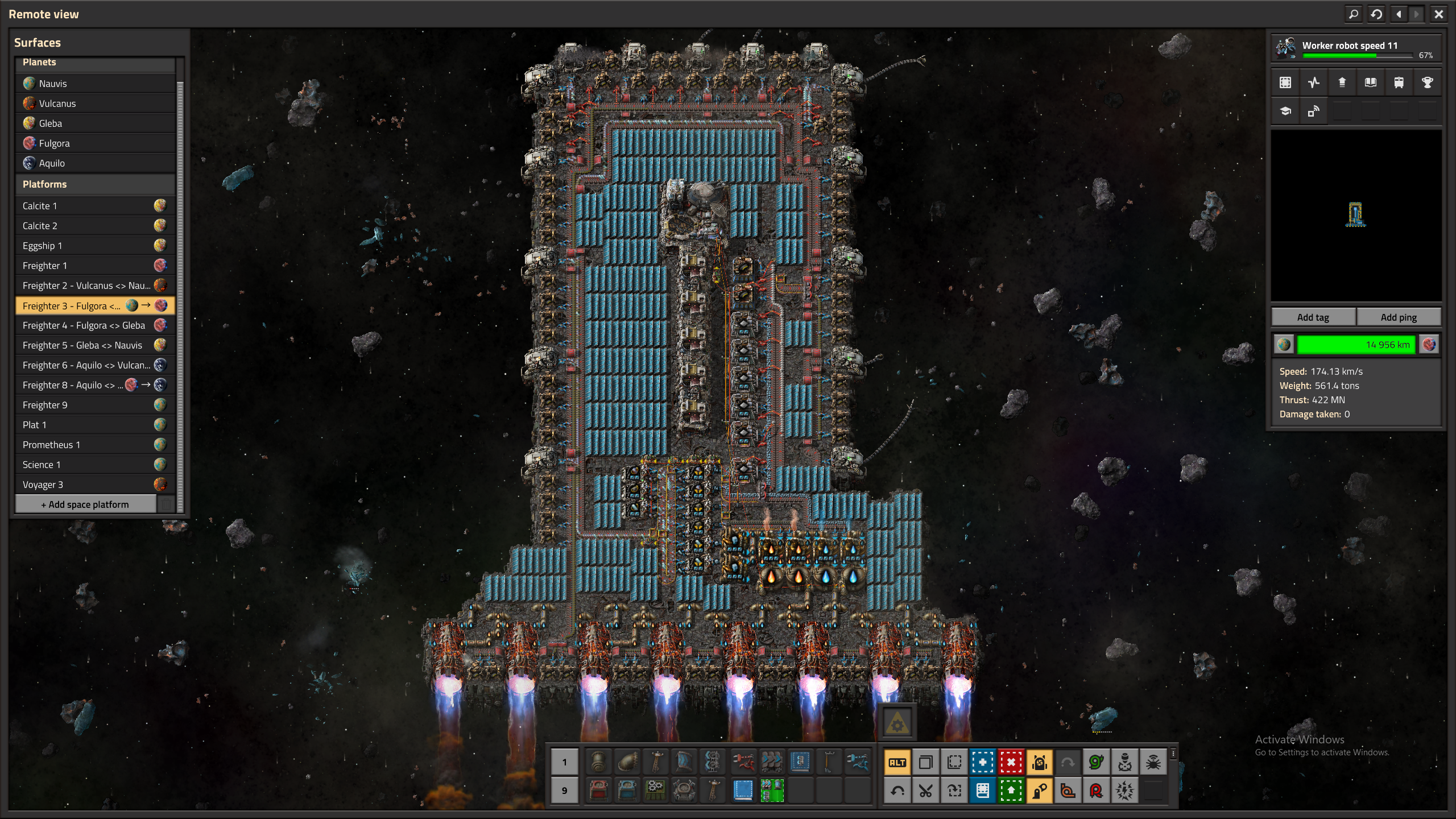
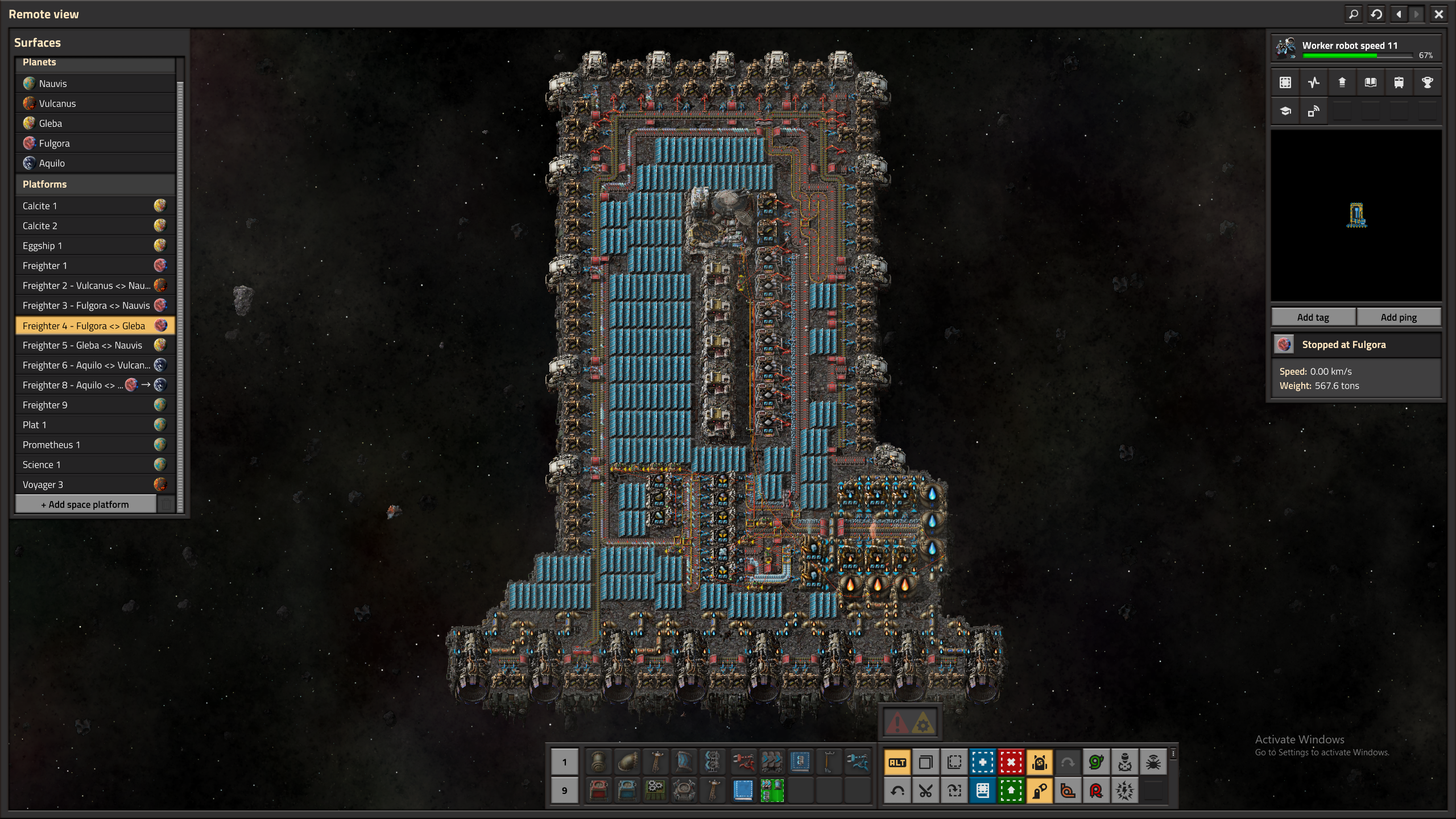
Freighter 4 represents a technological leap, rather than an optimization leap. The basic layout is the same, however fuel and asteroids are now processed using advanced recipes.
Additionally an additional furnace is inserted for producing ammo.
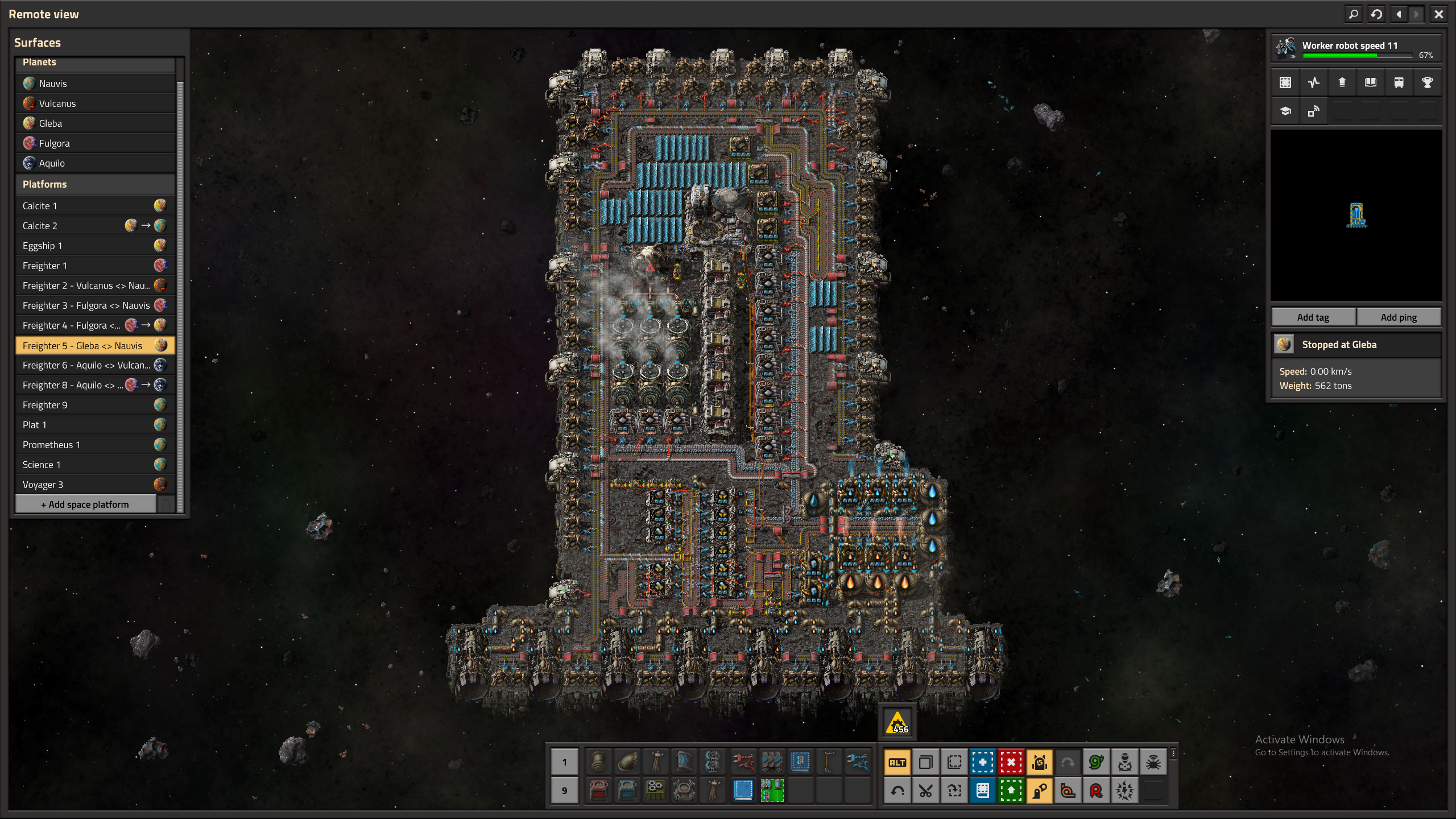
Freighter 5 is another technological leap: Now, power is generated using nuclear power. There are still a small number of solar panels in order to bootstrap the system, and to act as a failsafe (collectors need power to collect asteroids, crushers need power to generate ice, chemical plants turn ice to water, and nuclear plants need water to generate electricity).
With all the space saved by freeing up solar panels, some more asteroid processing (from 6 to 8 crushers) and ammo production (from 2 to 4 assemblers) is added, but the layout is otherwise the same.
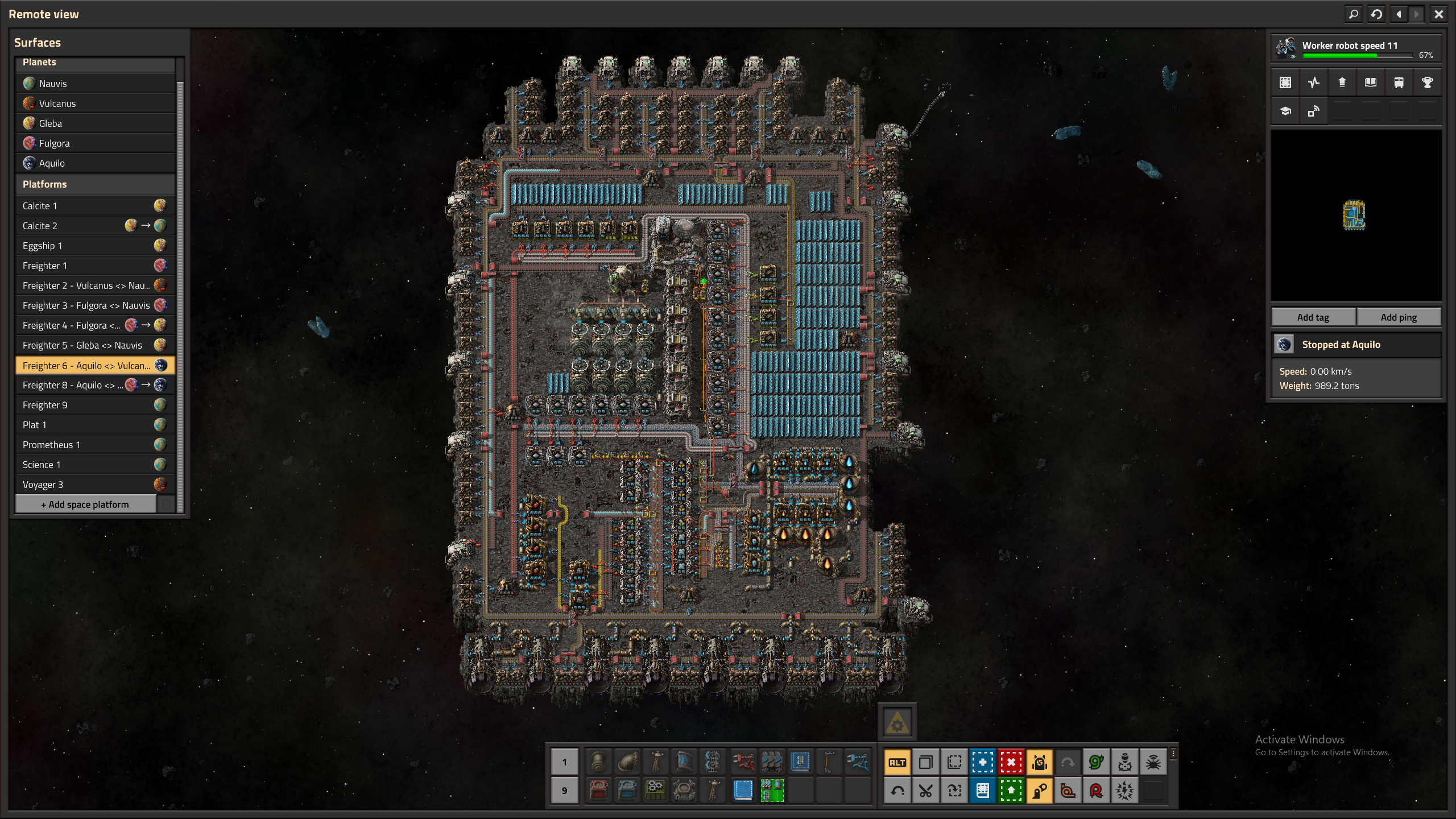
Where Freighter 5 was a technological leap, Freighter 6 was a logistical leap. Freighters were previously highly cost-optimized, however after Freighter 5 I had a new goal, to get to Aquilo, and my factory had been sufficiently expanded that building platforms was not especially difficult.
To that end, Freighter 6 is little more than taking Freighter 5 and expanding the body to match the width of the base. After all, at this point solar panels and foundation are cheap, so why not make it wide? As a result, there is a notable amount of free space, and belts make clean lines (especially notable around the ammo processing). This freighter retains all the same base systems: Belts between producers and consumers, a sushi belt with reprocessing for balancing, building resources on the fly. Freighter 6 additionally adds missiles to support its mission to Aquilo.
Freighter 7 was lost in an unfortunate freak accident, but it and Freighter 8 are copies of Freighter 6:
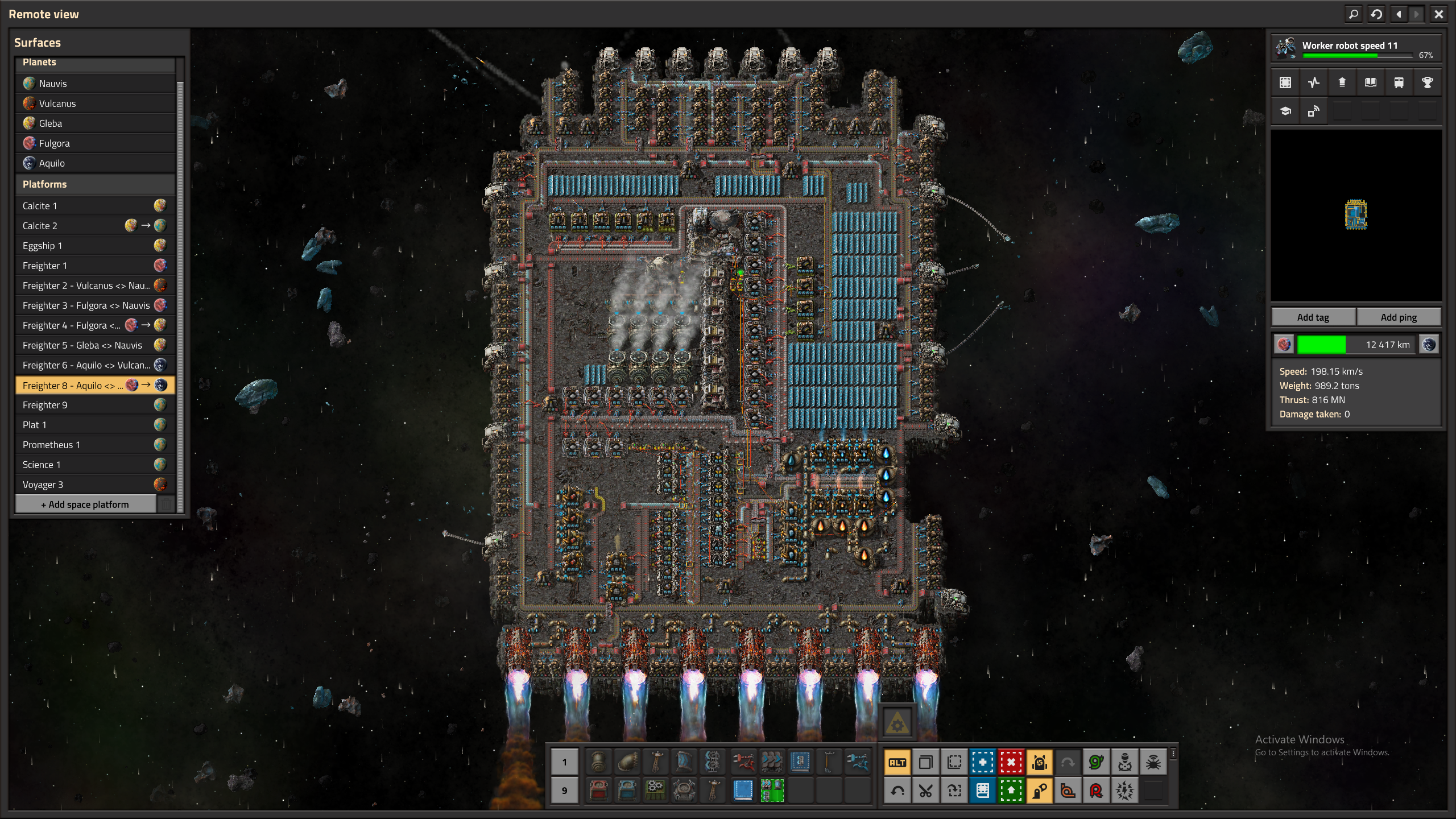
(Freighter 9 was never constructed)
But the evolutionary tree is not just a line - it has branches. Where the “Voyager” line was designed as a personal ship to explore bold new worlds, and the “Freighter” line was design to haul cargo, we had some other special-purpose lines.
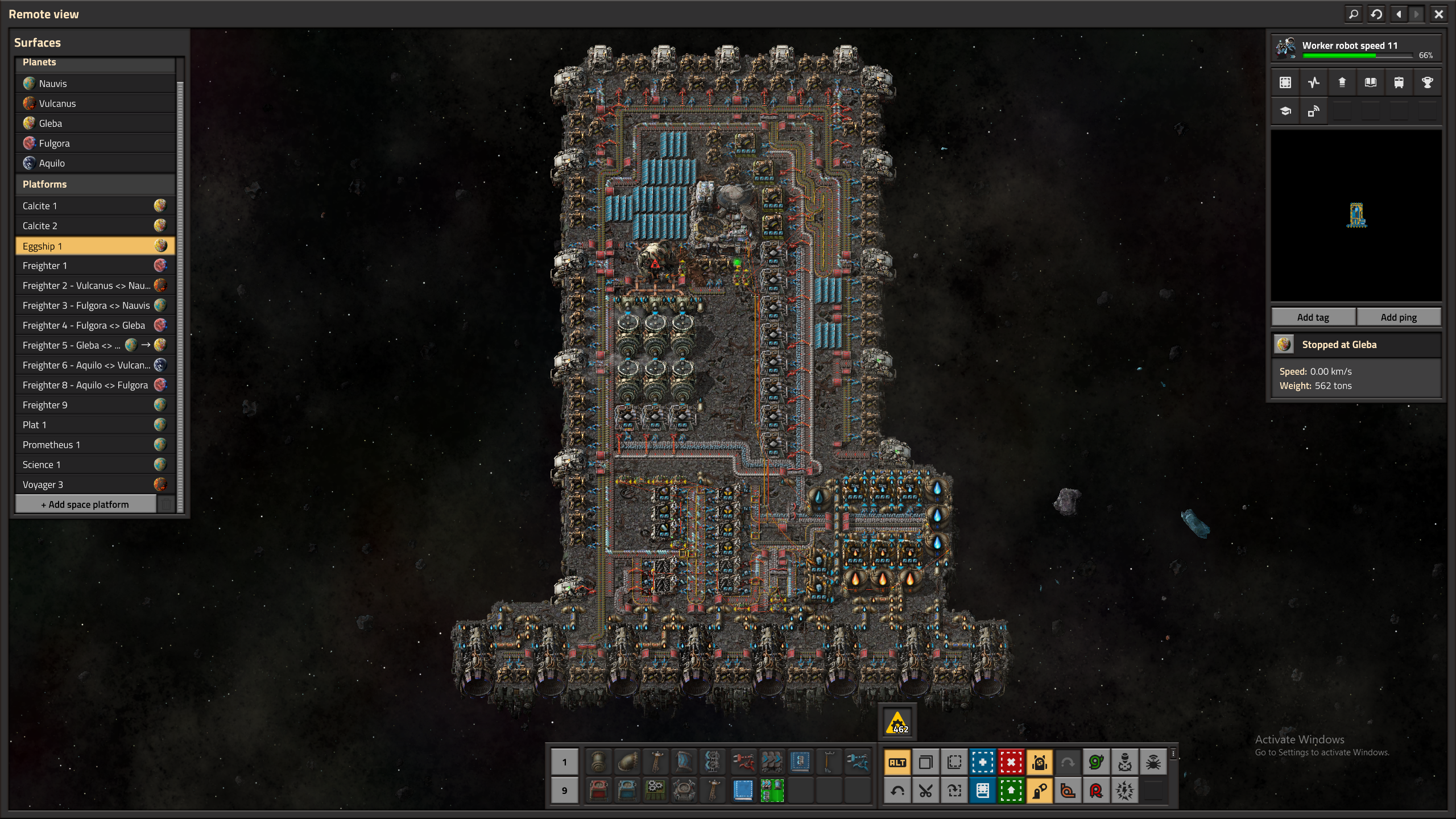
Eggship 1 was designed to carry biter eggs. Designed for the inner planets, it’s a clone of Freighter 5, but with specific defenses against biters that hatch. The cargo area is removed to reduce the area they hatch in, and the area replaced with turrets on the inside of the ship, near the hub.
(in this picture, you can also see the green light that indicates that the ship has all of the resources it needs to start a journey, which is present on most of the Freighter ships)
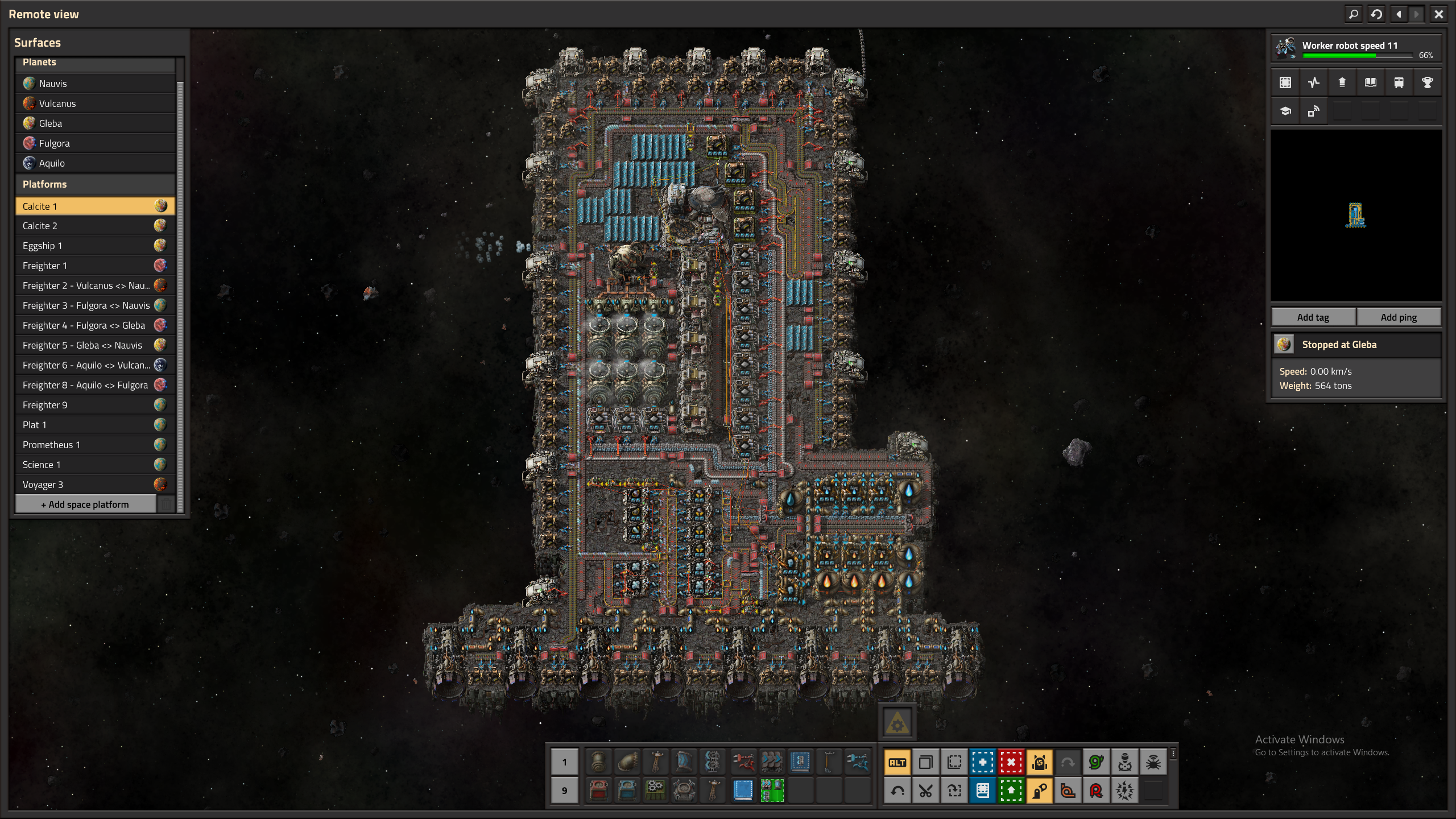
Calcite 1 and 2 are based off of Freighter 5, but with a single additional belt, to feed calcite produced back into the hub. These ships were designed to continuously fly between planets, accumulating calcite until they flew back to Nauvis to drop it off for smelting (thus saving having to, for example, launch calcite off the surface of Vulcanus).
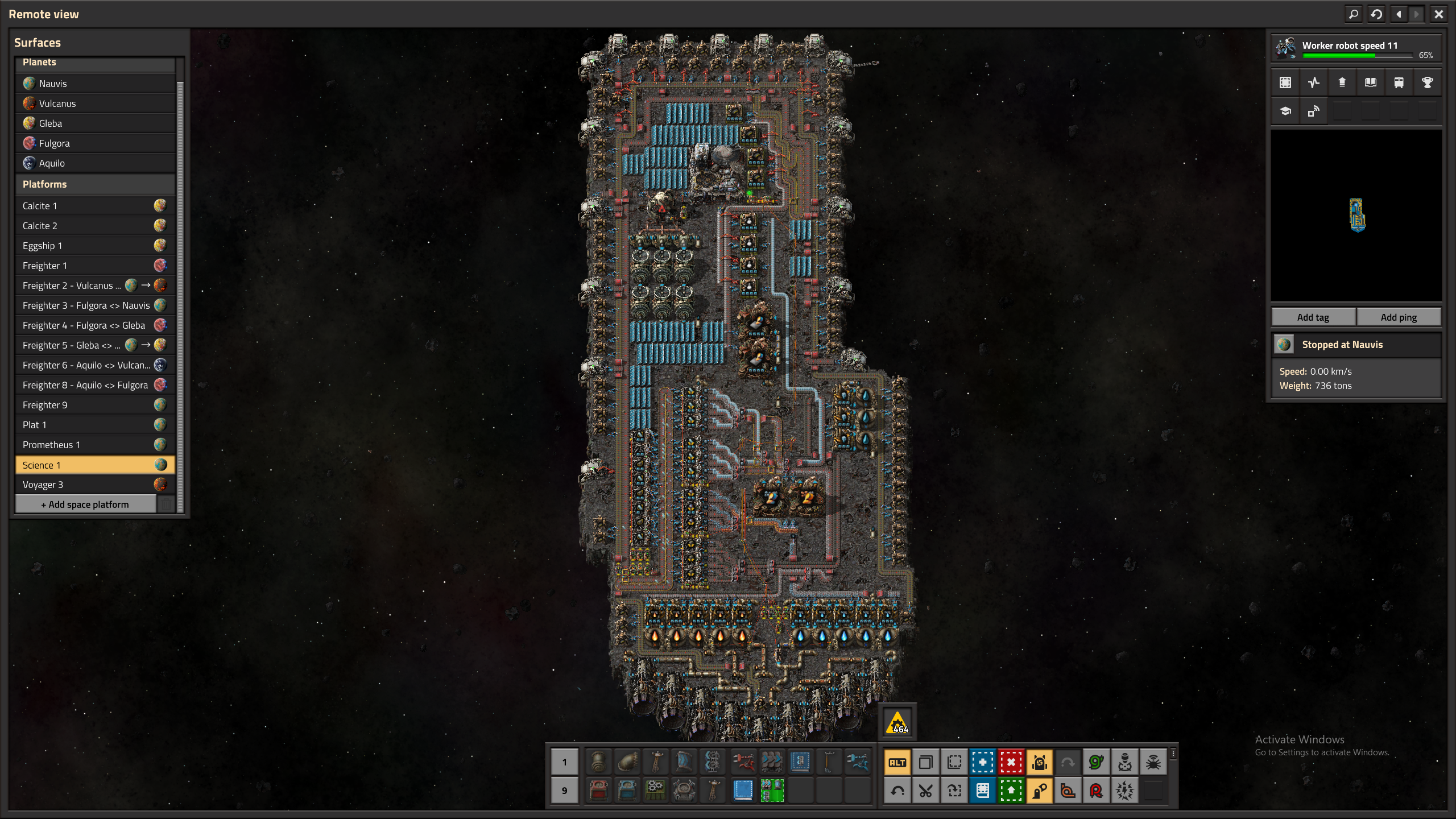
To bring it full circle: The first ship, Plat 1, eventually was unable to feed the science demanded of it. Therefore we see the last design in this tour: Science 1.
Science 1 was designed to go fast, continuously, generating science along the way. A new denser thruster layout increased the thruster count from eight to nine while narrowing their footprint. At this point I now had cheap access to foundries, and so used foundries to make iron plates. The space savings allow increasing the amount of fuel generation by 66% to feed more consistent propulsion. Asteroid processing was increased from a measly eight crushers crammed around the sushi belt to twelve.
(actually, looking at this picture now, I’m not sure what was up with the copper foundry.)
What was next? The next destination after Aquilo is sourcing prometheus, and so a new ship, a culmination of all the ships before, was in the process of being laid out and designed: Prometheus 1.